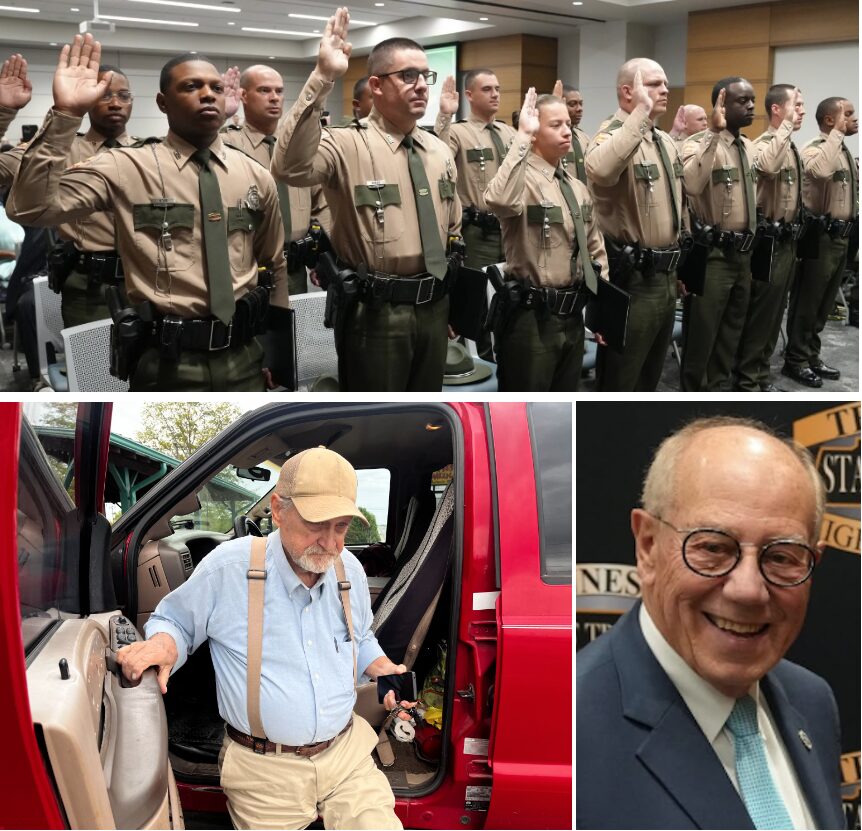
Jay Hirsch of Lawrence County, Tenn., lower left photo, Gnome Emeritus in Tennessee and a longsuffering Miracle Worker, dismounts from his truck outside a restaurant in Lawrenceburg. Jeff Long, safety commissioner overseeing state troopers, top photo, opppresses him and tens of thousands of Tennesseans with three rogue program, all litigated by Gnomes. (Photo David Tulis)
CHATTANOOGA, Tenn., Friday, July 24, 2026 — Odd as it might sound, miracle workers across the country are energized by exhaustion.
That is to say the absolutely novel and risky, dangerous, unpredictable claim that to its proponents appears to be a sure thing, grounded in bedrock legal infrastructure in every state.
The jolting allegation is that criminal traffic stops are fundamentally apart from law because they use the wrong type of law at the wrong time by a state government that has failed to exhaust its administrative remedies in seeking relief of its grievance against the American free-spirited traveler.
The concept has caught the attention of people around the country, some in the Volunteer State.
Brakota Smith, a Tennessee landowner who lives in Kentucky, has “developed a huge interest in what you are doing and what you are educating on.
“I’ve recently, and slowly but surely, started to understand your argument for subject matter jurisdiction. The terminology is becoming more clear and I would like to understand all I can. One of my biggest questions is: Do we just continue to refine the argument until a case is won for subject matter jurisdiction?”
Across the country at least a dozen people are seriously considering the law’s claims. North Carolina knee specialist Bill Parravano uses the analysis in court in Knoxville. Arthur Jay Hirsch, private businessman in mid-Tennessee in Lawrence County, argues the exhaustion analysis in front of general sessions judge Mike Harris, and wins dismissal, apparent insufficiency of charging instrument the grounds. Contractor James Austin Englett, also Lawrence County, is studying the issue and plans to use the exhaustion defense in front of the same judge.
In no time at all in God’s good providence, the earth-moving issue is in front of an appellate court. It’s in the case of remarkable defendent, Brenda Simpson, 77. In one of two cases, she wins dismissal in an eight-charge criminal trial May 21 in Savannah, Tenn., basing her affirmative defense on the exhaustion of administrative remedies analysis. The prosecutor scuttles the case, just after the jury is selected, willing to accept a scolding by the judge for violating the so-called Brady rule on sharing evidence with the defendant. Even though her case is dismissed, Miss Brenda files notice of appeal to address the problem of the fraudulent “history-only” driver license that props up the judicial branch’s unconstitutional denial in its various courtsof the right to travel.
In a separate case, much more significant, her pleadings on exhaustion are midway through review in the Tennessee Court of Appeals in Jackson, with oral arguments setto be scheduled.
Discovering foundational principle
Miracle Workers across the country are starting to understand that constitutionalists and patriots in past actions have had many of the right arguments, but have been missing the context rising from their state constitutions.
The context is privilege. The context is history. The origins of the right of travel are protected in the U.S. Supreme Court historicalperspective as set forth in New York State Rifle & Pistol Ass’n v. Bruen, 597 U.S. 1 (2022) and Hobbs v. Jackson Women’ s Health Organization, 597 U.S. 215 (2022) overturning Roe vs. Wade.
The winning argument appears to be, “Driving and operating a motor vehicle constitute a privilege.” We lift these words off the tongue of the cop and judge and show that it truly is directed at them and is not an offense to our exercising constitutional liberty. This statement has long been made by the “good people” or the white legal political establishment in every county and in every court across the fruited plain. It is so true that gnomes such as “private citizen” in California claim the criminal traffic stop must come to an end.
In Tennessee and every other state, privilege is the law under color of which the latitudinarian constabulary oppresses the right under the presumption of commercial use of the road. The claims of liberty through the origin of privilege and all the early cases indicate that a dark turn occurred after 1920 in the heart of government to blight the liberties of the people in their use of the public road.
Ordinary vs. extraordinary
Privilege is the foundation of automobile regulation in the extraordinary use of the public right of way, as opposed to the ordinary use to which it is put by ordinary working people such as you.
Privilege according to the jurisprudence of Tennessee cases starting before the Civil War is always an economic act for profitable and taxable in the public interest because the act affects the public. Privilege is a calling, trade or profession effectively owned by the state with rules approved by the state.
The privilege analysis is crucial because the courts have followed the lead of the general assembly to obscure the origin of the privilege in economic activity. In Tennessee, the general assembly crafty altered privilege by defining it in terms of the
The exhaustion of administrative remedies doctrine forces the court to start with the origin of the regulation of transport. The carrier and motor vehicle bodies of law are rooted in privilege and cannot be pulled away from the premise of economic regulation. It will be important for defendants to insist that the officer allege and provide evidence in the “traffic stop” of commercial activity, such as bills of lading, passenger list, contracts as well as visual evidence of people who are paying riders or cargo in boxes or crates.
On this site, I have published several scripts detailing the approach one could make in either testifying from the stand or interrogating the officer.