Arthur Jay Hirsch leaves the courthouse in Lawrenceburg Monday after a hearing in which he challenges criminal prosecution of traffic infractions, saying his case must be heard by the commissioner of safety. (Photo David Tulis)
LAWRENCEBURG, Tenn., Monday, April 12, 2026 –– A judge says that if the administrative law were to control the administration of motor vehicle privilege in Tennessee, “an administrative clog” would choke itself to death and “nothing could be done.”
General sessions court Judge Mike Williams fends off in an early use of an unprecedented defense to criminal traffic cases in the U.S., opining in a hearing in Lawrenceburg, Tenn., that criminal court has subject matter jurisdiction to hear the state’s case against Arthur Jay Hirsch.

Judge Mike Harris
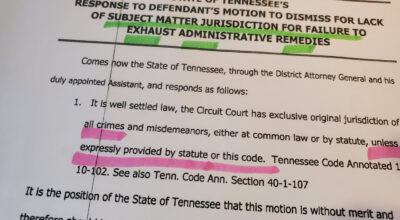
“‘We recognize as the general rule that where and administrative remedy is provided by statute, relief must be sought by exhausting this remedy before the court will act,’” Mr. Hirsch says, peering through a black magnifying glass, quoting Tennessee Enamel Mfg. Co. v. Hake, 183 Tenn. 615, 620, 194 S.W.2d 468, 470 (1946). (1)
He says the state as the moving party must fulfill its administrative duties by taking its allegations of misconduct to the issuer of the license for review. American courts developed the exhaustion doctrine in the 1930s in the rise of the administrative state.
“Whenever there is a contested case concerning licensing,” Mr. Hirsch says, “the jurisdiction first is with the department of safety in Nashville. They have been given the authority to try cases. They create all the rules and regulations, and they also will administer any contested cases under the uniform administrative procedures act, title 4 section 5. Driving is a privilege. Privileges are heard in first instance at the administrative level.”
Mr. Hirsch says the constitution and title 55 of the Tennessee code establish the privilege framework. Mr. Hirsch says that if a commissioner doesn’t hear a case himself, he has a “designated hearing officer” or administrative judge to hear the case with option of judicial review – meaning court. The commissioner of safety is BillLee appointee Jeff Long, a lawyer and former law officer.
‘Purely administrative’
Mr. Hirsch says at a one-hour hearing that the criminal prosecution is “premature and untimely” (he no doubt means “unripe”).
“As soon as we resolve that issue (of special appearance and right to challenge jurisdiction) *** I say I feel that there is subject matter jurisdiction for me to take this case,” the judge says. “That’s where we are today.”
Mr. Hirsch, “the fiddle man of Lawrenceburg” who distributes free large print Spanish/English Bibles, and who uses the public right of way by right for enjoyment of his Christian and constitutional liberties, is being prosecuted for three administrative breaches.
No driver license. No registration. No insurance.
The judge says that because the motor vehicle law is in the Tennessee code, he has jurisdiction to hear the case. “This is not an administrative issue,” he says, “this is a jurisdictional issue with me.”
DA sits mute
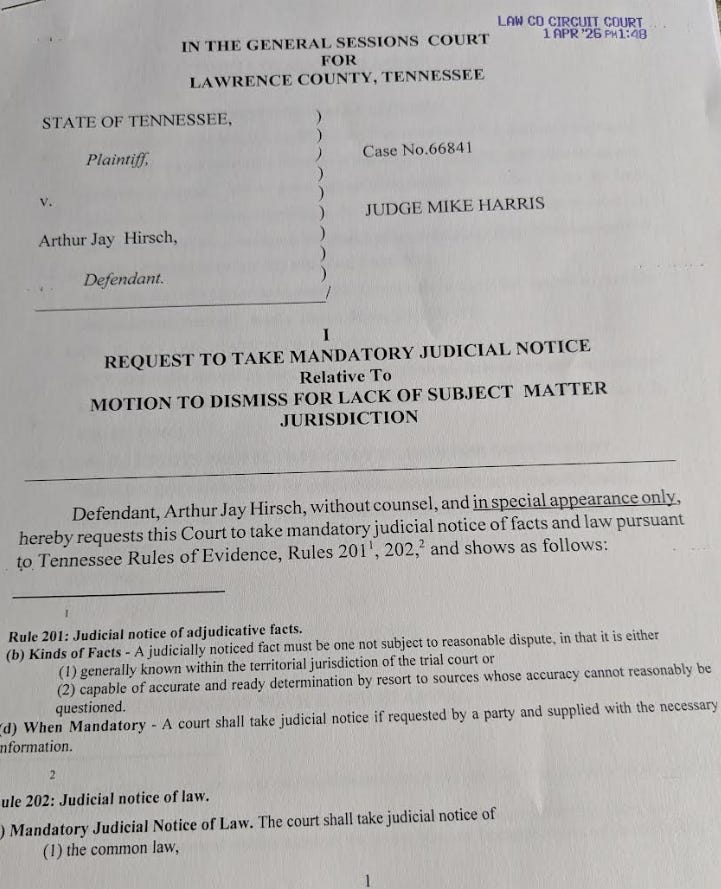
Judicial notice is a powerful tool.
Mr. Hirsch insists asking twice whether the judge read his mandatory judicial notice citing the rules of evidence and the supremacy of constitution and state law.
“I have, I have.”
The judge brushes away the citations as federal, but Mr. Hirsch says that Rule 202 regarding mandatory judicial notice requires he examine all cited authorities.
“I have taken mandatory judicial notice, judicial notice,” Judge Harris says, “and I still find in taking notice under the rules of evidence that this court has jurisdiction.”
General sessions court in Tennessee is a court of convenience, with bench trials and no record. A party that loses in general sessions may appeal de novo within 10 days into circuit court or criminal court for a trial by jury.
The judge made no comment regarding this reporter’s letter requesting comment on his willingness to let DA Cooper’s employee sit silently and twice mumly refuse to defend his subject matter jurisdiction. Judge Harris says he got the Tennessee Supreme Court order in my lawsuit against him regarding use of my recording equipment, the order dismissing the case as moot.
(1)The full quote from Tennessee enamel is “The doctrine of exhaustion of administrative remedies requires that where an administrative remedy is provided by statute, relief must be sought by exhausting this remedy before the courts will act.”