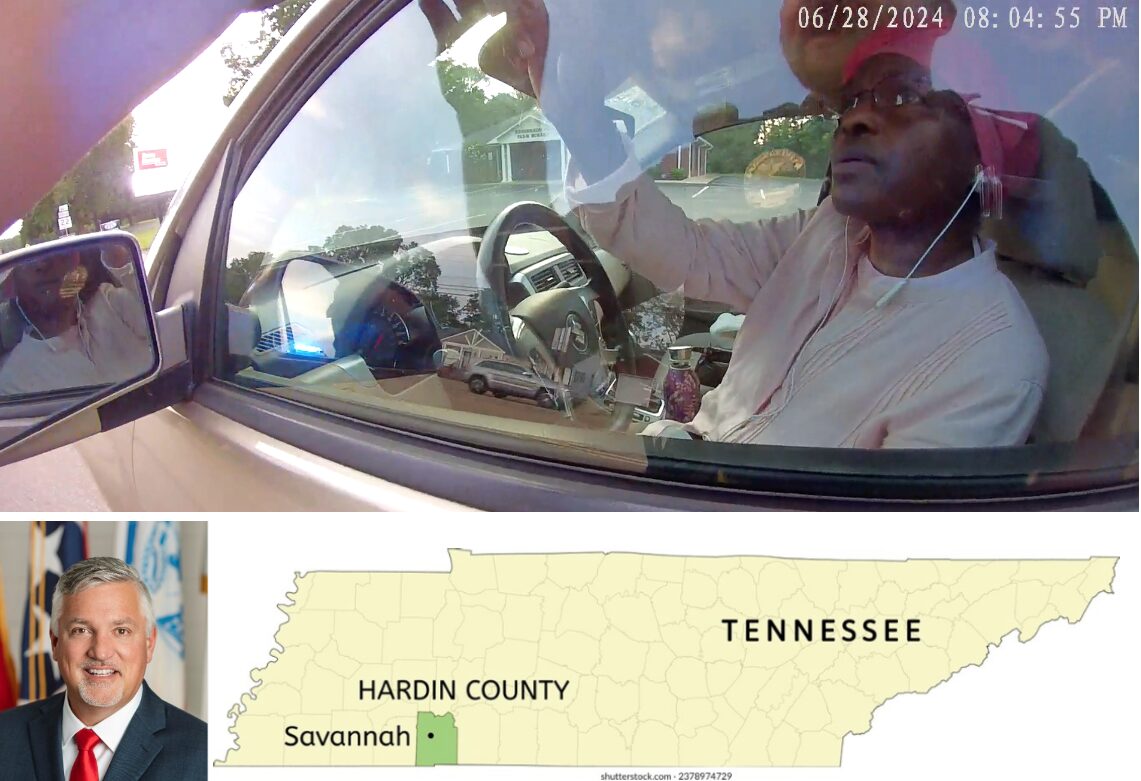
Police officer Devon Stevens in Lexington, Tenn., in Henderson County, top photo, initiates a June 28, 2024, “traffic stop” against Brenda Simpson. In a similar Hardin County case, circuit court judge Brent Bradberry, bottom left, is denying her right to make a due process defense on failure to notice. (Photos Lexington police department, AOC)
“The defendant may not argue or suggest to the jury that her driver’s license was improperly, suspended due to lack of notice,” says judge Brent Bradberry in Hardin County circuit court.
“The state contends that lack of notice is not a valid defense in this case because Ms. Simpson had previously been cited twice for the same offense before the conduct at issue in the present charges. The court agrees. Because the defendant had prior citations for the same offense, alleged improper notice of the original suspension is not relevant to any material issue in this trial.”
Judge Bradberry says “under Tennessee rule of evidence 402, irrelevant evidence is inadmissible.”
The April 20 gag order prohibits Mrs. Simpson “from making any argument or statement to the jury regarding alleged improper notice of her driver’s license suspension.”
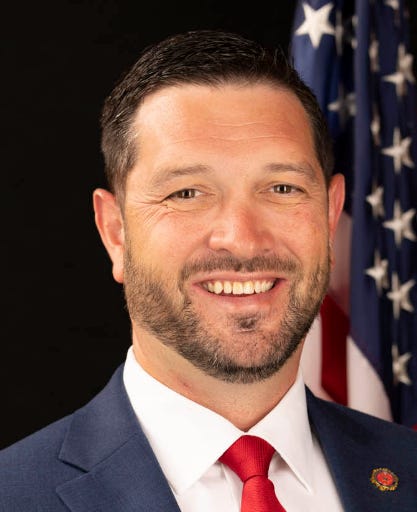
DA Neil Thompson, 24th judicial district
Local police, acting in the name of the state, have created four criminal cases against Mrs. Simpson and put her in jail for two months and four days in one case.
Underlying the order is the rule which says that relevant evidence “may be excluded if it’s probative value is substantially outweighed by the danger of unfair, prejudice, confusion of the issues, or misleading, the jury, or by considerations of undue delay, waste of time, or needless presentation of cumulative evidence,” as recited in the state’s Jan. 6 motion.
The prosecutor says further that “any arguments the defendant wishes to make as to the properness of her driver’s license suspension should have been raised with the Tennessee Department of Safety/Homeland Security through their administrative procedures.”
The prosecutor insists that “the state has no obligation to prove the defendant was a ‘driver in the transportation of passengers for hire or other profit.’” Commerce is one of the essential elements of driving and operating a motor vehicle that, under an honest judge, has to be alleged and proven. Courts in Tennessee obey policy set in secret judicial conferences that there is no right to travel and that the distinction between private and for-profit use of public roads is meritless.
The order appears based on fear that the public is catching onto this powerful and impeachable legal fiction. However, this wariness by the judge is misplaced because jurors, as members of the public, have for decades been told that there is only commercial use of the road under license and that anyone who attempts to use the road privately is a scofflaw unwilling to share in the burdens of civilized society.
Mrs. Simpson, a devout Christian, is a public notary whose address is known to the state. When the state sent through department of safety a notice of suspension, it sent the notice to her old address. But Mrs. Simpson had since then moved to 4165 Lonesome Pine Road in Savannah, another house on the same road.
Plain error
“They are cutting the tongue out of her mouth,” says Christopher Sapp, mid-state bureau chief of NoogaRadio Network.

‘The judge is just being an ass,” he says. “The state is trying to muzzle a valid defense. There needs to be an interlocutory appeal to overturn the state’s motion in limine as it unconstitutionally encroaches upon Brenda’s right to access the jury and to present a fact issue for their consideration. It violates several constitutional concepts. The jury is charged with fact and credibility determinations as well as the law itself.”
“It has long been recognized that ‘fairness can rarely be obtained by secret, one-sided determination of facts decisive of rights. . . . [And n]o better instrument has been devised for arriving at truth than to give a person in jeopardy of serious loss notice of the case against him and opportunity to meet it.’” Joint Anti-Fascist Refugee Committee v. McGrath, 341 U. S. 123, 170-172 (Frankfurter, J., concurring).
Princely warfare against principalities & powers
David runs a personal nonprofit fighting and mercy ministry. He thanks you for checks sent directly to c/o 10520 Brickhill Lane, Soddy-Daisy, TN 37379. Also at GiveSendGo at the link above.