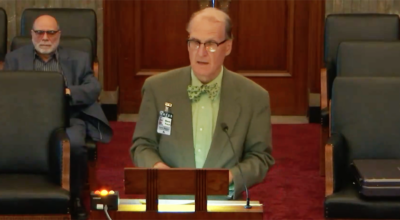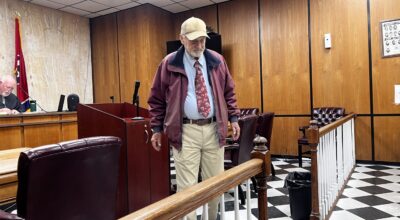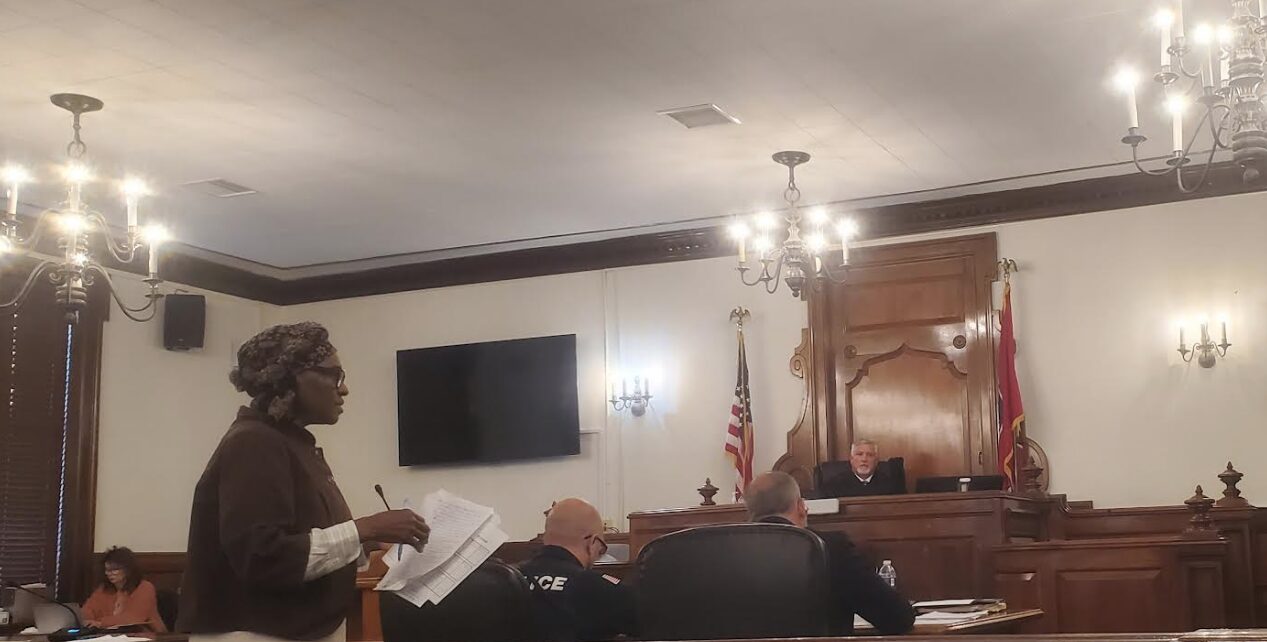
Brenda Simpson queries jury members at the start of her trial May 21, 2026, in Savannah, Tenn. (Photo David Tulis)
SAVANNAH, Tenn., Thursday, May 21, 2026 – A judge dismisses five criminal counts against free-traveling Brenda Simpson, 77, who insists she has an absolute right to travel the public roads in rural Hardin County.
Judge H. Brent Bradberry of Hardin County circuit court clearly is stumped that prosecutor Neil Thompson fails to provide Mrs. Simpson two of three sets of evidence, including bodycams in the two “traffic stops” available at his office. District attorney Thompson’s assistant, Adam Jowers, two days before trial, invites her to come to their office to view them. But Mrs. Simpson is stranded. She lives 13 miles outside Savannah and is forbidden to use the roads under criminal penalty from Mr. Thompson.
Simpson says the judge is flabbergasted. “He was. He was upset with [Mr. Jowers] for not following procedures.”
“Even sometimes after the jury has been [picked], the cases settle,” Judge Bradberry tells jurors after dismissing the case for violations of the so-called Brady rules of sharing evidence.
“This matter has been disposed of. So your time as a juror is complete.”
“I’m so happy,” murmurs Pam Williams, a supporter, half in disbelief.
Mr. Thompson does not return Friday a call to his Huntingdon office requesting comment.
“They invited me to come Tuesday to watch the videos,” says Mrs. Simpson. “They weren’t even available Monday. I could come on Tuesday. In a trial that’s on Thursday. The Most High —.” Ecstatically, Mrs. Simpson chuckles. “[ADA Jowers] was so sure of himself. He’s won many cases like this. He’s put many people in jail for driving on suspended license, revoked license and whatever. And so he was so confident that he was so lax in what he was doing.”
In a nutshell ——————————
➤ Judge finally spots prosecutorial rot in driving-while-black case
➤ Mrs. Simpson vindicated in her Christian beliefs
➤ Criminalization of traffic allegations facing strong challenge
Says Shirley Foulks, a Miss Brenda friend serving as private chauffeur: “By me bringing her to court when she needed to go, I learned a lot. It is not lawful for them to make us have a driver license. To make us even have insurance for that matter. By her driver’s license expiring, she did not renew it, which means when it expired — it expired. They were trying to say that when it expired, she should have renewed it. But expiration means, ‘I don’t have to move forward with it.’ And she proved that in court.”
So intent is Mrs Simpson on vindication that on Wednesday she had a friend take her to Nashville with a subpoena for Tiffanie Morgan, a department of safety employee responsible for issuing fake driver licenses and suspending them. The trip proved fruitless.
Mrs. Simpson stands apart from other Americans who think they live in a “free country.” On basis of her fixed confidence in God and his promises to her, she resists since 2019 the pretense that nodding jurors accept in voir dire: The duty to stay off the public roads except under privilege for which they must apply and pay.
The Tennessee constitution allows for two forms of taxation, one of them being privilege. Tenn. Const. art. 2, sect. 28. Driving and operating a motor vehicle constitute a privilege no different from plumbing, embalming, podiatry or scrap metal dealing.
The police in Savannah, like those in every city, use criminal police power to administer the privilege, which is economic police power regulation. Only troopers have authority to aid departments of safety and revenue in managing traffic. Municipal poaching and fee generation are a universal practice in the U.S., also known as “policing for profit.”
In matters of privilege, the state must exhaust its administrative remedies under the uniform administrative procedures act before going to court. Of the roughly 50 privileges in the state only the motor vehicle privilege is treated by use of criminal police power initially.
Mrs. Simpson files an unprecedented motion to dismiss premised on the exhaustion remedy. Judge Bradberry, on thinnest grounds, denies it.
5 counts
Judge Bradberry tosses two “driving without a valid license“ cases, two “driving without valid registration” cases, and one count of failure to show proof of financial responsibility. The last count is premised on a fraudulent reading of T.C.A. § 55-12-139, enforced by departments of revenue and safety and under suit for fraud by this reporter.
For decades, cops, municipal corporations and courts have had easy wins against a general public ignorant of the limits of the motor vehicle law. Only recently has a strong defense developed by an improved understanding in Tennessee of the privilege mechanism, the analysis led by Arthur Jay Hirsch in nearby Lawrence County.
Mrs. Simpson works as a caregiver and sitter for the elderly. She gives healthy eating classes and is involved in her church. She refused a public defender, though her appellate court case is filed in forma pauperis.
Had Judge Bradberry scolded the prosecutor in public about his ethical duty to impartiality required of the courts, he could have generated a huge amount of political capital and public goodwill in his re-election. Jurors would have strolled out of the courthouse after their dismissal and said, “Wow, what a judge.” It also would have curbed DA Thompson’s relish to outlaw private travel in breach of the constitution.
The prospect of decriminalizing traffic stops to end to Jim Crow and pre-civil war-era type controls on the public appears remote. If reforms in this long-standing usage and abusage occur, it likely will be in local areas where belligerent claimants in person live. Courts committed to commercial policy and never challenged in the general assembly for impeachable wrongs are unlikely to ease familiar abuses.
Government cartel trembling
The Thompson blunder is inexcusable, a reportable BPR offense. But it shields the state from from Mrs. Simpson. Attorney general Jonathan Skrmetti’s brief defending criminal enforcement of Tennessee’s commercial government system is due to the Tennessee court of appeals the day after the trial, May 22. The appeal by Mrs. Simpson in an earlier case challenges criminal traffic stops under “invidious class discrimination” in the privilege system, citing the exhaustion of administrative remedies doctrine.
Citizens freely access troves of material about state frauds available on the Internet. Artificial intelligence’s brief window of cheap availability lets commoners such as Mrs. Simpson or “gnome librarian” Ed Soloe in Alcoa, Tenn., rip into the state’s quasi-religious pretense that no private travel exists except for change of domicile interstate under the 1997 Booher case.
Mrs. Simpson appears to be outflanking the unlawful attainder that lets cops operate against every private or non-licensed traveler. Judicial policy holds the right of ingress and egress as a meritless claim, a “sovereign citizen” theory to be swatted down prejudicially. The state’s hegemony over the roads shows wear, its godhead requiring more and more local political – and legal – capital to defend in the state’s 95 counties and 31 prosecutorial districts.
Relief for Judge Bradberry
Judge Bradberry may be relieved at the prosecutors’ foozle.
He OK’d Mr. Thompson’s motion to bar Mrs. Simpson from using her primary defense. He ordered her not to cite the fact that the suspension of a fake driver license “assigned” to her by the department of safety was done without giving her notice or a hearing. Calling this evidence “irrelevant,” Judge Bradberry snipped the tongue out of her mouth to protect the state from being prejudiced by a senior citizen defending herself pro se. Reversible error, likely; slightly ridiculous, certainly.
To maintain his integrity, judge Bradberry refused to recuse himself and denied a motion for interlocutory relief on his gag order. Saying that Mrs Simpson settled is simply not true and implies a plea bargain. Rather lie about collapse of the state’s case than speak ill of a familiar, it seems.
While the judicial branch is often considered the third part of government, it is actually the first part and the leading part. Slippage as against the law is strongly evident in the judicial branch.
This reporter challenged the 2020 Covid-19 swindle in court. He fought Hamilton County’s Redcoat warrants and criminal traffic stops. He combatted court-approved MCA vampire lending. He fought to pry open illegally secret judicial conferences in which Messrs. Bradberry and Thompson participate, as if in a masonic lodge. He’s litigating the Tennessee financial responsibility law extortion racket in three cases. By publishing and on Tiktok he reports on the defeat of Tennessee’s die-hard pre-Civil War travel pass system for blacks and others.
In every controversy he’s filed in the public interest, judges have not adhered to the law. They joined oppressors in violation of God’s law, state law, honorable court precedents and judicial ethics rules.