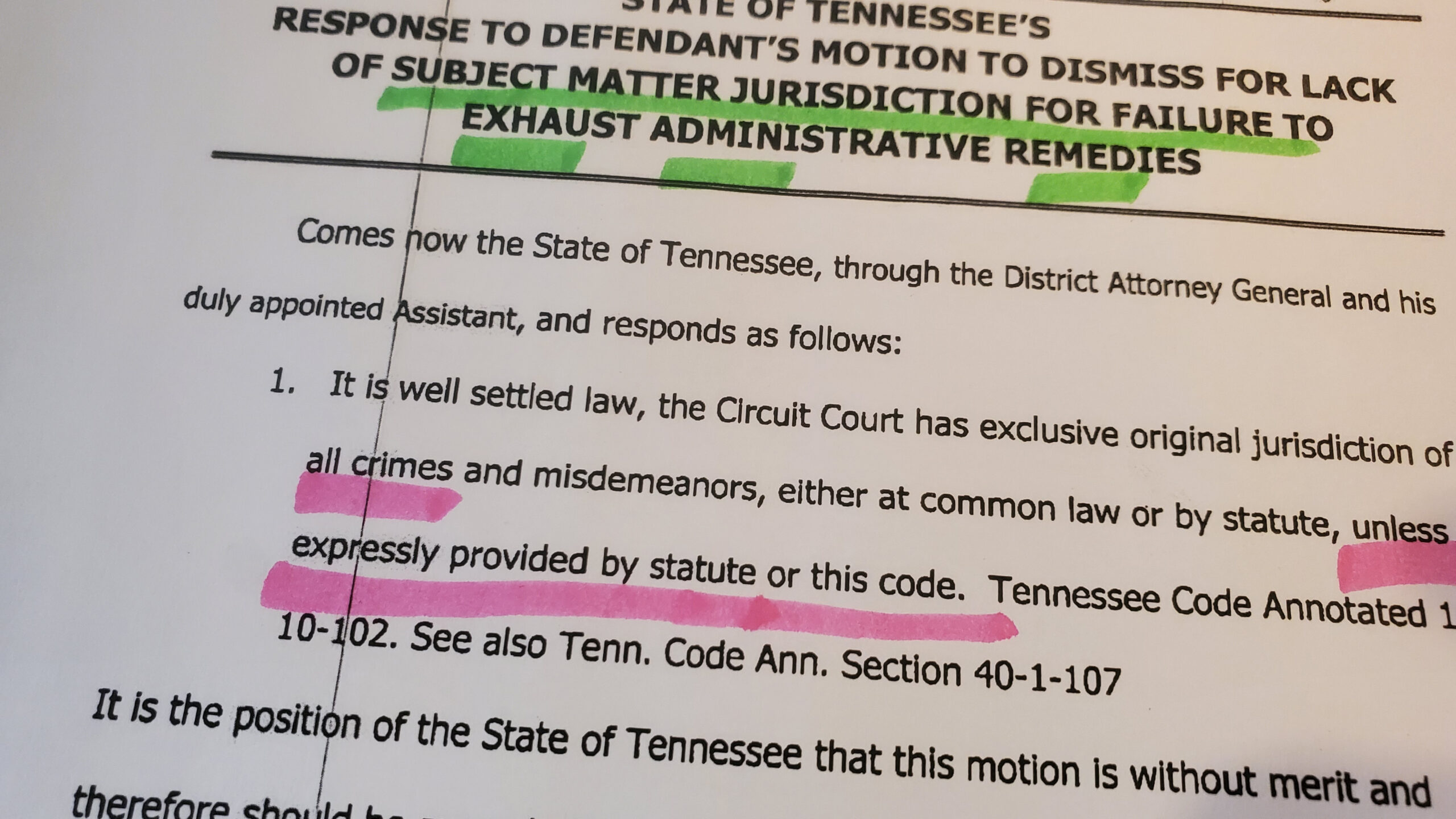
A filing by the state asks circuit court judge Brent Bradberry to ignore the longstanding doctrine of exhaustion of administrative remedies in a privilege enforcement case turned criminal against Brenda Simpson, 76, of Savannah, Tenn. (Photo David Tulis)

Brenda Simpson insists law be made to work to void her criminal prosecution and May 22 trial in Hardin County, Tenn. (Contributed photo)
Saturday, May 2, 2026 — A district attorney argues against use of the exhaustion doctrine in a criminal traffic case, citing the general statute giving circuit courts criminal jurisdiction, a law with a loophole large enough through which to drive a semi-tractor with a trailer attached.
Neil Thompson, the district attorney for Hardin County, Tenn., argues that the state has no duty to prosecute allegations of privilege wrongdoing administratively. Statewide, privilege dispute is handled under economic police power in what are called administrative contested cases.
In rebutting defenses by Brenda Simpson of Savannah, 76, accused of three crimes regarding traffic, Mr. Thompson says the law gives circuit court original jurisdiction of all crimes, “unless expressly provided by statute.”
He cites T.C.A. 16-10-102,
- The circuit court has exclusive original jurisdiction of all crimes and misdemeanors, either at common law or by statute, unless otherwise expressly provided by statute or this code. [emphasis added]
He also cites T.C.A. 40-1-107 that says,
- Original jurisdiction of criminal actions is committed to the courts of general sessions, city judges of certain towns and cities, the circuit courts, the criminal courts and the court for the trial of impeachments.
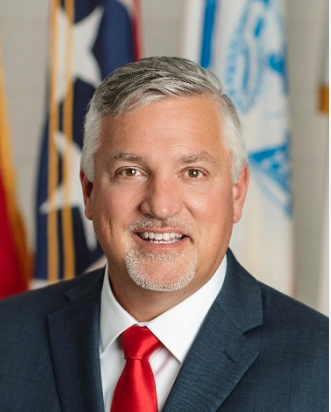
Circuit Judge J. Brent Bradberry
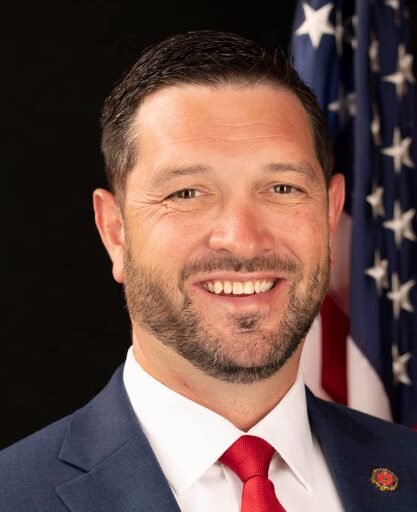
DA Neil Thompson 24th udicial district
However, Tennessee law provides alternate means of the state’s pursuit of its interest as regards privilege “unless expressly provided by statue or this code.”
The exception accounts for Mrs. Simpson‘s defense, which is that the state has failed to exhaust it administrative remedies and is pursuing her outside of lawful sequence that accounts for the concepts of privilege, judicial economy and due process.
Mrs. Simpson says in a motion that the movant state must exhaust its administrative remedies under longstanding and well-known doctrine. Its remedies are civil. They are administrative. A controversy regarding a license requires the licensor to hold a contested case to hear allegations against a licensee.
Tennessee has about 50 privileges, each with its own administrative regulatory board or overseer. Hairdresser controversies are heard in the barber board. Plumbers are heard in the contractor board. Accountants are heard in the accountancy board.
Mrs. Simpson is making a defense without of first impression in Tennessee. Defendants in criminal cases and their lawyers have waived or failed to make the argument she is making in what is called an affirmative defense.
A devout Christian, Mrs. Simpson says she intends to an halt a longstanding irreparable harm by the state against his own people, those ostensibly the sovereigns as described in the Tennessee constitution in art. 1, sect. 31. And that is taking the privilege of driving and operating a motor vehicle and enforcing it criminally in a way no other privilege is administered.
Crime and violence versus civility
The criminalization of privilege administration has been in process since at least 1937 with the arrival of the driver license law. The first major ruling on the driver license was in 1940, Sullins v. Butler, pointing out that the relationship between the state and the citizen is equitable. In other words, criminal provisions in traffic laws don’t convert these laws into strict liability criminal laws.
The relationship is civil and equitable, under a department.
Despite the criminal penalty provisions in the three allegations made against her, Mrs. Simpson says it is the state duty to make its claims in the proper venue, the correct court, which is the office of the commissioner of safety, Jeff Long, who employs ranks of administrative judges to serve him.
A system designed for harm, profit
This space filled by local governments that do not have administrative authority or capacity, but which use peacekeeping and criminal police powers to “administer” the rules of the road provisions.

Troopers administer the traffic laws in service to the department of safety, which is authorized to manage all disputes regarding driver licenses. (Photo DOSHS)
The department of safety alone in law exercises administrative and economic police power over the privilege of using the roadways commercially. State troopers are its enforcers of the commercial law. Since World War II, local governments have cooperated with and relished the unfunded mandate to administer traffic law. It gives them revenues and support for their courts. It justifies their commercial existence through ultra vires use of criminal police power under a justice-industrial complex.
DA Thompson‘s office’s citing the law fails to develop the exceptions. Traffic laws have misdemeanor penalties attached. But the law requires that the sequence of administration begin with administrative hearing in the department responsible for the regulable and taxable activity.
Safety is the court of original jurisdiction, which point Mr. Thompson trusts the court will ignore and so continue its management of the prosecution and proceed to trial against Mrs. Simpson on May 22 in Savannah.
The fighting and mercy reporter at GiveSendGo
David runs a personal nonprofit fighting and mercy ministry. He thanks you for checks sent directly to c/o 10520 Brickhill Lane, Soddy-Daisy, TN 37379. Also at GiveSendGo at the link above.