Ed Soloe of Alcoa, a handyman known as the “Gnome librarian” for his extensive reading in law, says he will tidy locks and garb for trial May 7 in Blount County, Tenn., and look like a real miracle worker. (Photo David Tulis)
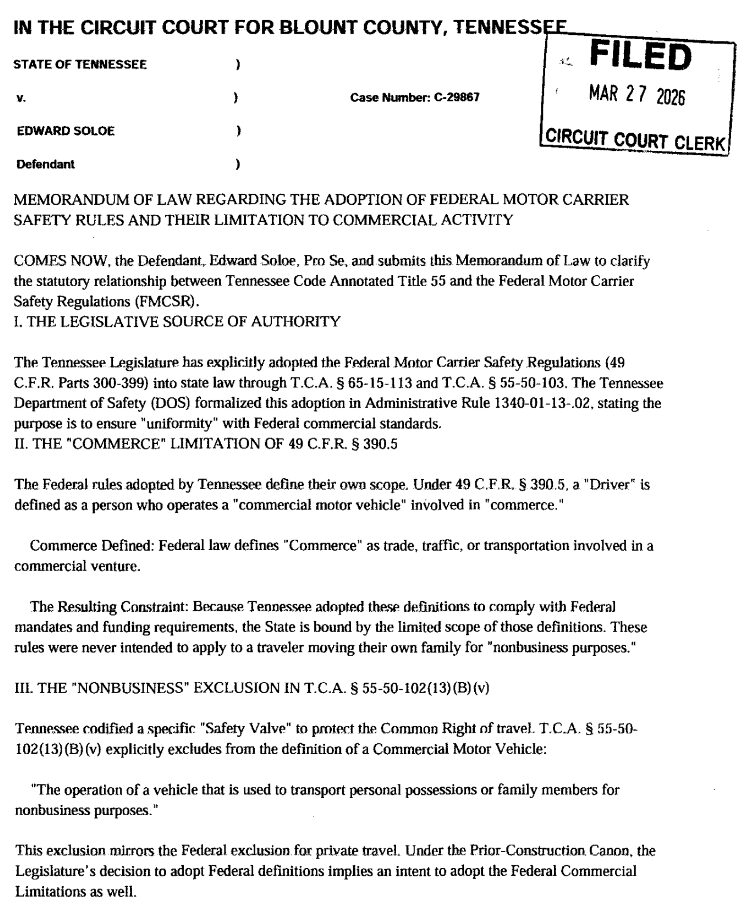
Soloe says federal law controls traffic regulation. I. THE LEGISLATIVE SOURCE OF AUTHORITY The Tennessee Legislature has explicitly adopted the Froeral Motor Carries Safety RP.gulations (49 C.F.R. Parts 300-399) into state law through T.C.A. § 65-15-113 and T.C.A. § 55-50-103. The Tennessee Department of Safety (DOS) formalized this adoption in Administrative Rule 1340-01-13-.02. stating the purpose is to ensure “uniformity” with Federal commercial standards. II. THE “COMMERCE” LIMITATION OF 49 C.F.R. § 390.5 The Federal rules adopted by Tennessee define their own scope. Under 49 C.F.R. § 390.5. A “Driver” is defined as a person who operates a “commercial motor vehicle” involved in “commerce.” Commerce Defined: Federal law defines “Commerce” as trade. traffic, or transportation involved in a commercial venture. The Resulting Constraint: Because Tenn adopted these definitions to comply with Federal mandates and funding requirements, the State is bound by the limited scope of those definitions. These rules were never intended to apply to a traveler moving their own family for “nonbusiness purposes.”
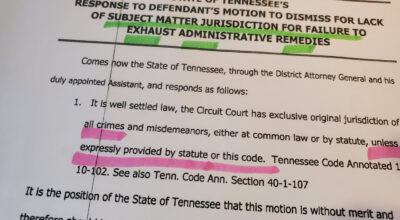
Gnome librarian Ed Soloe is going on trial May 7 in Maryville, Tenn., loading the district attorney’s office with petitions and motions indicating that there is an underlying fraud in the suspension of his tag.Mr. Soloe will include among his defenses the lack of notice by department of revenue in suspending his tag just after he had paid to renew it.
Memorandum of Law & Authorities
Mr. Soloe of Alcoa, Tenn., is up against a judicial policy contrived years ago in illegally secret judicial conferences run by the chief justice and the administrator of the courts. The policy holds that private travel does not exist except for a change of domicile interstate.
The judicial branch cinched this jesuity in 1997 in State v. Booher, 978 S.W.2d 953, *953; 1997 Tenn. Crim. App. LEXIS 799, in which the court of appeals drafts a trick sentence intended to be misread by every district attorney statewide. Since that time judges and DAs all misread the sentence as they’re supposed to — that no right to travel exists, and that motor vehicle regulation does indeed abrogate and derogate free movement and free travel.
Mr. Soloe, a feral handyman and mechanic who lives with his wife in a “section 8” apartment complex, is a subject matter expert on the Tennessee financial responsibility law of 1977. He tracks down fraud by two departments. I am suing two appointees of Gov. Bill Lee in any of three court cases, one in U.S. District Court in Nashville.
Mr. Soloe has called me as a fact witness regarding the operation of the TFRL and the fraudulent no-notice operation of this revocation system. It’s not clear whether the judge will allow me to cover the trial if I’m a witness.
The department of revenue forces people to buy insurance they cannot afford to obtain policies that are legally insufficient, according to filings in Tulis, v. department of revenue and State ex rel. Tulis v. David Gerregano, commissioner of revenue et al.
In an important filing, Mr. Soloe says that Tennessee law reflects federal law, which is exclusively upon commercial motor vehicles. Federal law very clearly excludes private travel. He cited the prior-construction canon for a true reading of the law.
His filings contradict officials’ pretense that the privilege of driving and operating motor vehicle has nothing to do with economic dealings between citizens and the state. He deals with significant issues in “notice of *** binding precedence and statutory construction.”
All three branches of government cooperate in violating Tennessee constitution art. 11, sect. 16, forbidding pretense.
§ Booher trick sentence in italics.
We agree with the appellant that he enjoys a fundamental right to freedom of travel. See Dunn v. Blumstein, 405 U.S. 330, 338, 92 S.Ct. 995, 1001, 31 L.Ed.2d 274 (1972); Knowlton v. Board of Law Examiners of Tennessee, 513 S.W.2d 788, 791 (Tenn.1974). Travel, in the constitutional sense, however, means more than locomotion; it means migration with the intent to settle and abide. Id. Thus, any American is free to travel from state to state, and to change his state of residence or employment whenever he desires, unrestricted by unreasonable government interference or regulation. See 16A C.J.S. Constitutional Law § 478 (1969). Whether a specific type of travel is protected by one’s constitutional right to travel depends upon the intent which motivates the movement. Id.
In the present case, the appellant asserts that the State of Tennessee has unduly infringed upon his “right to travel” by requiring licensing and registration of his motor vehicles prior to operation on the public roadways of this state. However, contrary to his assertions, at no time did the State of Tennessee place constraints upon the appellant’s exercise of this right. His right to travel within this state or to points beyond its boundaries remains unimpeded. Thus, not only has the appellant’s right to freedom of travel not been infringed, but also, we cannot conclude that this right is even implicated in this case. Rather, based upon the context of his argument, the appellant asserts an infringement upon his right to operate a motor vehicle on the public highways of this state. This notion is wholly separate from the right to travel.
State v. Booher, 978 S.W.2d 953, *953; 1997 Tenn. Crim. App. LEXIS 799