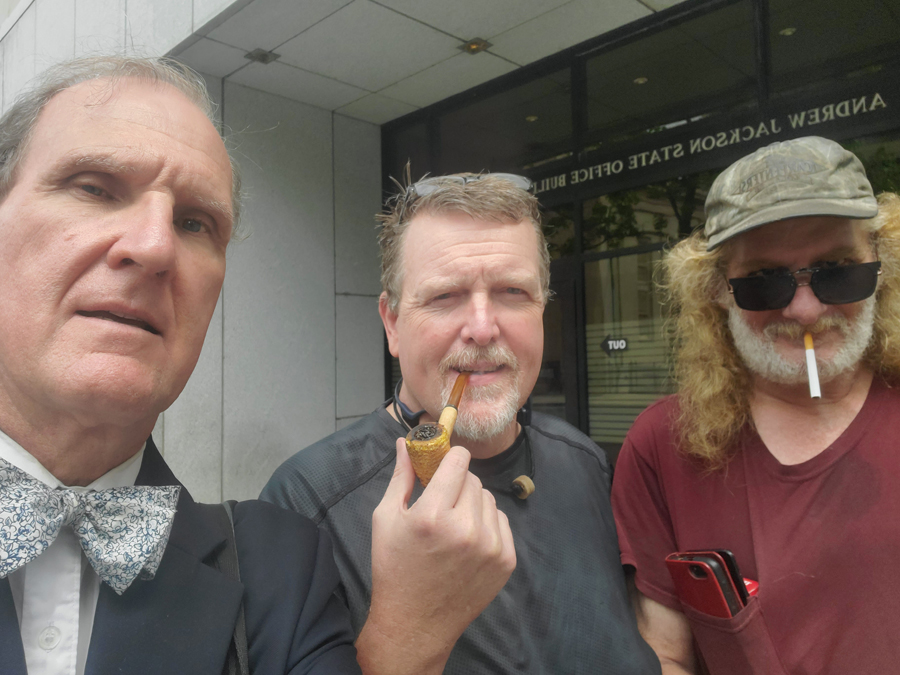
From left, David Tulis of Eage Radio Network and “gnomes” Christopher Sapp, midstate bureau chief for Eagle Radio, Sparta, Tenn., a bulldog reporter and commentator; and Ed Soloe, Gnome librarian, Alcoa, Tenn., self-taught feral handyman who studies law when not fixing his neighbor’s brakes or air conditioner. (Photo David Tulis)
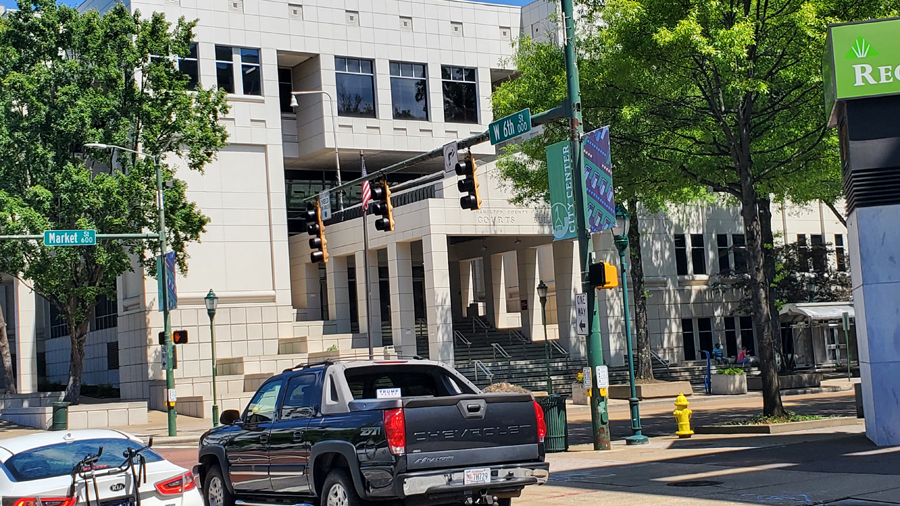
This garish building in downtown Chattanooga is the county courthouse, housing the sheriff”s office and the DA’s office. (Photo David Tulis)
CHATTANOOGA, Tenn., Monday, Oct. 13, 2025 — I plan to serve the following notice and demand on six local Hamilton County, Tenn., officials, a document based on filings in my lawsuit against Sheriff Austin Garrett, deputy Brandon Bennett and the county. The county attorney has waived all argument on privilege, the role of uniform administrative procedures act and the doctrine of exhaustion of administrative remedies .
My suit, and this notice, claim that driving and operating a motor vehicle constitute a privilege. That means that wrongdoing allegations under the law regulating the privilege must be heard by the agency or department that issues the privilege. Driver licenses are issued by the commissioner of safety. Traffic stops are to be performed by that department using economic police power. The parties I’m suing to halt various illegal acts use criminal police powers illicitly, prematurely and unconstitutionally against licensees of the department of safety.
The nation’s entire traffic stop jurisprudence is permissive under criminal standards under the 4th amendment. But, reasonably, economic police power rules must come into play first — before any criminal activity can be alleged. The case Tulis v. Bennett is without precedent in American legal history, according to my reading into the cases.
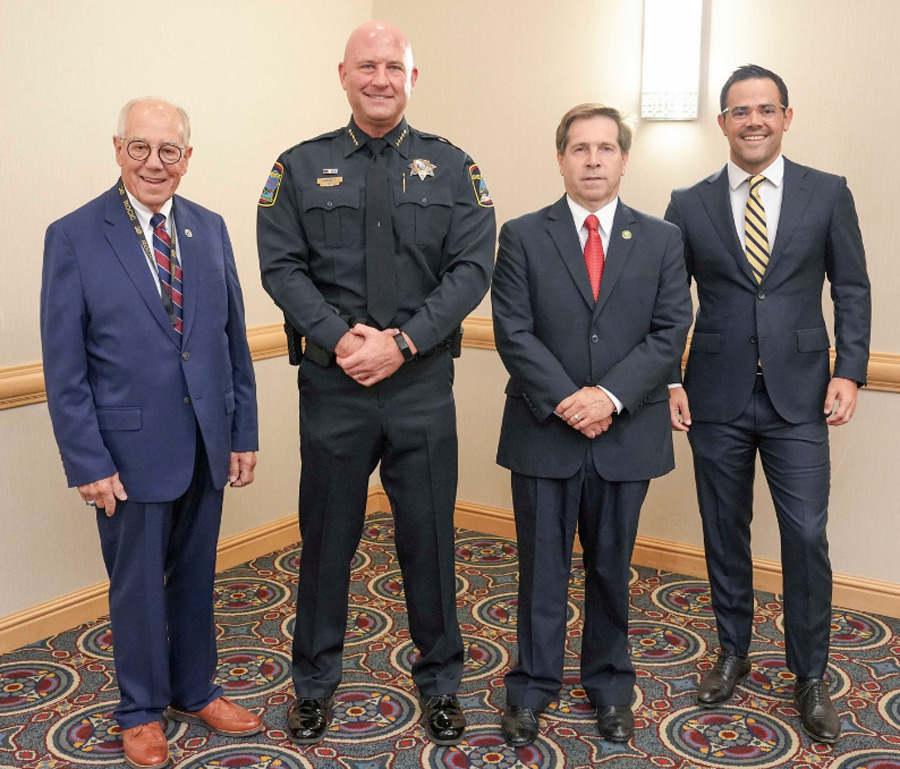
From left, Jeff Long, commissioner of safety; Sheriff Austin Garrett; Congressman Chuck Fleischmann; and Hamilton County Mayor Weston Wamp. With perhaps the exception of Rep. Fleischmann, who supports bombing civilians in the Mideast, all agree to criminal enforcement authority for privilege administration when clear and well-known law calls for administrative hearings in the department of safety, and no criminal enforcement until a last resort of the citizen loses in agency and in court and refuses to comply with terms of his driver license application. (Photo HCSO)

Coty Wamp is district attorney in Hamilton County, Tenn. (Photo Coty Wamp)
Plan to serve the sheriff, Janie Varnell the interim county attorney, district attorney Coty Wamp or the AG Jonathan Skrmetti and the county risk management department. Other parties are included in this week’s round of service.
The county not only ignores limits in the motor vehicle law in title 55, it ignores the constitution in running a general warrants scheme, aka “redcoat warrants,” as I call them. Dee Hobbs defends these breaches of law in U.S. district court and in the appeal to the 6th circuit.
I propose people across the U.S. review their respective state constitutions and statutes to draft similar notices and file similar suits in their states.
The key elements.
-
Privilege
-
Authority of commissioner of safety (DMV)
-
UAPA, or uniform administrative procedures act
-
Exhaustion of administrative remedies, a well-known and long established legal doctrine
####
“Notice on Administrative Referral”
NOTICE AND DEMAND FOR ADMINISTRATIVE REFERRAL OF PRIVILEGE-RELATED ALLEGATIONS SUBJECT TO UAPA
- Privilege status. The use of state-created driver licensing to operate a “motor vehicle” on public ways is a state privilege, administered by statute. See Tenn. Const. art. II, § 28 (tax/privilege authority) and T.C.A. Title 55, chapt. 50 (driver licenses).
- Administering department. The department of safety and homeland security (“DOSHS”) and its commissioner administer the driving privilege, including licensing, suspension, and revocation. See T.C.A. § 4-3-2005; T.C.A. Title 55, chapt. 50.
- Contested-case hearings exist by statute. When the state alleges misuse or grounds to affect a driver license, the legislature provides a contested-case hearing before DOSHS before the commissioner or a designated hearing officer, with judicial review. T.C.A. § 4-3-2005; T.C.A. § 55-50-502, -509, -511 (notice; right to a hearing; review); T.C.A. §§ 4-5-301 to -325, uniform administrative procedures act (“UAPA”), contested cases & review.
- Agency primacy. Tennessee law recognizes that licensing questions tied to the use of public highways in commerce are administrative in nature. (“[T]he grant or refusal of a license to use public highways in commerce is purely an administrative question” McMinnville Freight Line, Inc. v. Atkins, 514 S.W.2d 725, 726–27 (Tenn. 1974); “[T]he Utilities Commission has never been held by this Court to be restricted by the technical common law rules of evidence in determining purely administrative questions, and we have held that the grant or refusal of a license to use public highways in commerce is purely an administrative question” Hoover Motor Express Co. v. R.R. & Pub. Utils. Comm’n, 195 Tenn. 593, 616, 261 S.W.2d 233, 243 (1953) (emphasis added).
- UAPA authority. Pursuant to T.C.A. § 4-3-2005, a contested case is under UAPA.
- Federal compliance mandate. In regulating the use of “every way publicly maintained that is open to the use of the public for purposes of vehicular travel,” the department of safety “shall abide by all federal rules and regulations relative to the issuance, suspension, and revocation of driver licenses and qualification of drivers” T.C.A. § 55-50-504.
- Exhaustion of administrative remedies required. Where the legislature vests a department with primary responsibility and supplies a contested-case route with judicial review, parties exhaust administrative remedies before courts exercise coercive power. Colonial Pipeline Co. v. Morgan, 263 S.W.3d 827, 838–39 (Tenn. 2008). Exhaustion protects department primacy where law vests administration in the agency and provides review in chancery or circuit court.
DEMAND
- Referral rule. Therefore, upon any allegation tied to misuse or violation of the driving privilege (licensing status, conditions or privilege-based obligation), county employee has no authority but to refer the matter to DOSHS for a UAPA contested case (§§ 4-5-301 to -326 / § 55-50-120) rather than initiate criminal enforcement.
- No criminal short-circuit of privilege procedure. Initiating warrantless arrests or criminal prosecutions to adjudicate privilege-status questions short-circuits the statutory administrative channel, defeats the longstanding exhaustion rule and violates due process where law supplies an exclusive remedial path for handling privilege controversies.
- Notice given (prior and present). The county and its officers have been served notice regarding (a) the scope and limits of title 55 privilege administration (March 1, 2018) and (b) limits on warrantless arrest authority for non-breach-of-peace matters, T.C.A. § 40-7-103 (April 15, 2020). Instant notice consolidates those notices for present and future reliance.
- Instruction to personnel. Effective upon service, the county commission, sheriff, deputies, county attorney, district attorney, county risk manager and all personnel exercising peacekeeping powers under T.C.A. § 8-8-213 each put on awares to refer a privilege-related allegation against a motor vehicle driver/operator to DOSHS for contested-case proceedings that preserve the administrative record for judicial review. T.C.A. § 4-5-319.
- Reservation / evidentiary use. Failure to comply with this routing demand will be treated as evidence of deliberate disregard of notice and of agency-channel evasion in any subsequent administrative, civil or appellate proceeding.
- Party serving this notice and demand reserves all rights, grants no waiver.
####
Drafted by David Jonathan Tulis, ℅ 10520 Brickhill Lane, Soddy-Daisy, TN 37379 Tel. 423-316-2680 Davidtuliseditor@gmail.com
Princely warfare against principalities & powers
David runs a personal nonprofit fighting and mercy ministry. He thanks you for checks sent directly to c/o 10520 Brickhill Lane, Soddy-Daisy, TN 37379. Also at GiveSendGo